
Provides safe, secure, and high-performance products and solutions. Core products include AutoCore.COMM and AutoCore.OS, along with integrated CCU/ZCU hardware and software, and SDV solutions. These enable the rapid and cost-effective development of next-generation in-vehicle computing platforms.
A hardware-software integrated in-vehicle central computing platform designed for OEMs, helping them rapidly build differentiated next-generation smart vehicle platforms.
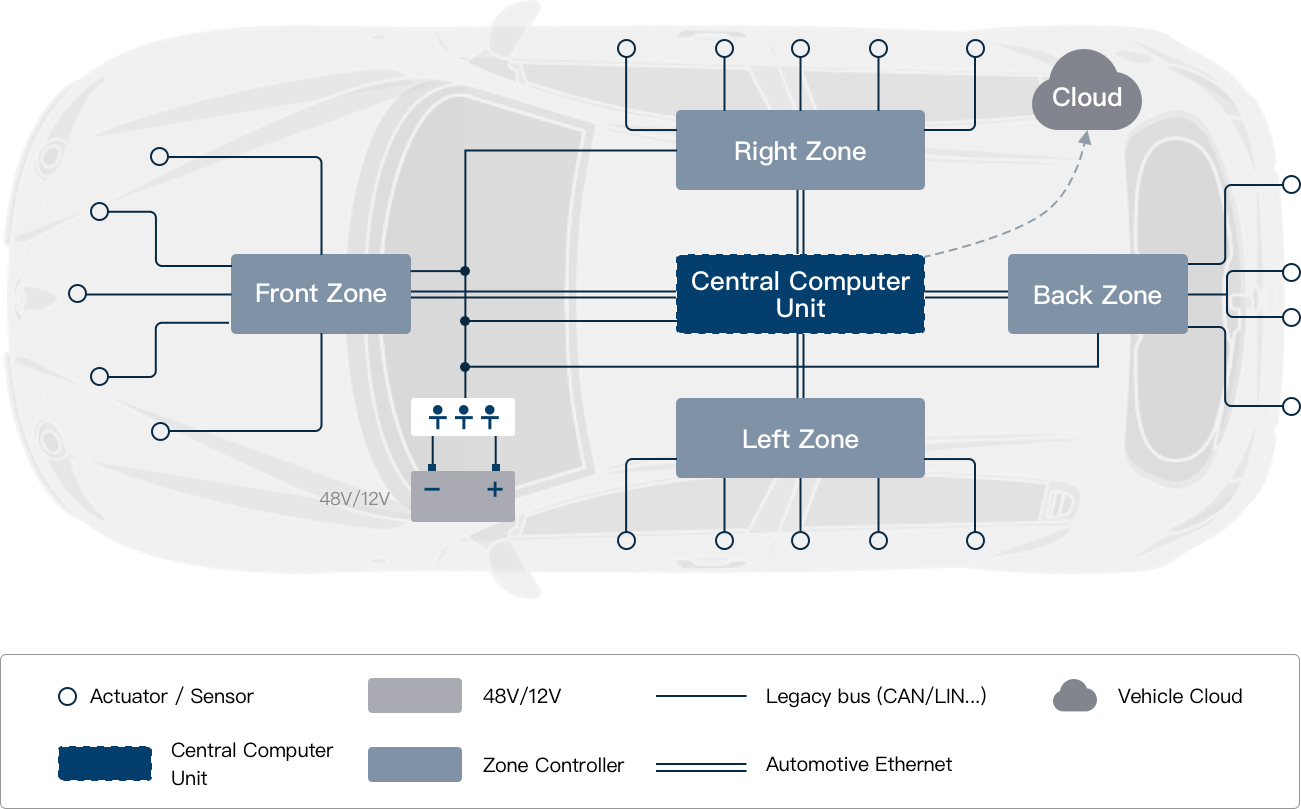
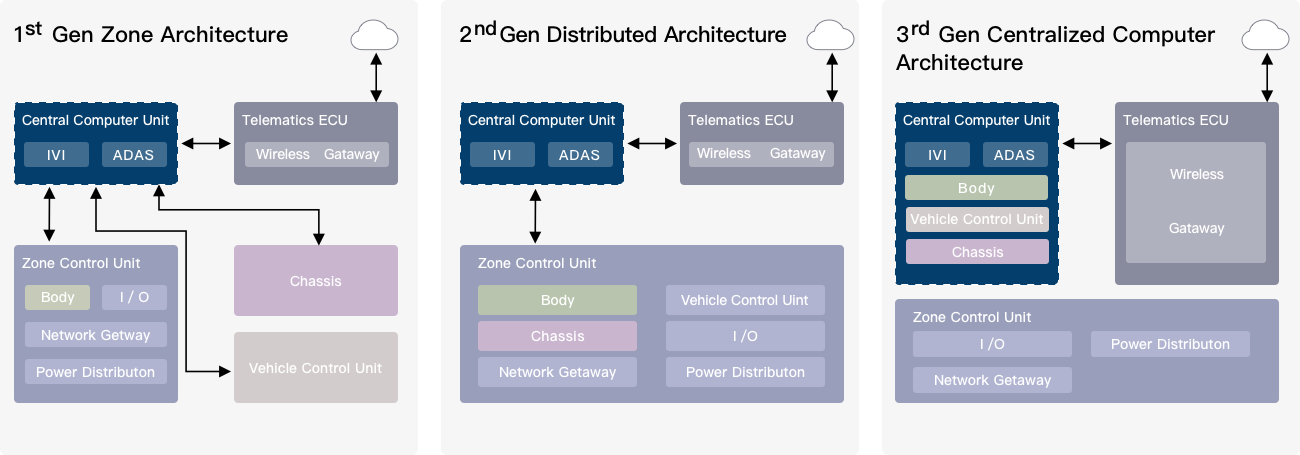

Supports collaborative operation of multi-core CPUs, GPUs, NPUs, DSPs, and other heterogeneous computing units, providing powerful parallel processing capabilities to meet the high-computing demands of intelligent driving and smart cockpits.

Utilizes virtualization technology to isolate safety-critical and non-safety-critical tasks, ensuring system safety while improving resource utilization.

Breaks the isolation of traditional ECUs, enabling deep integration of autonomous driving, cockpit, gateway, and other domains on a unified platform, enhancing system integration and collaboration efficiency.

Employs a high-bandwidth, low-latency data bus architecture to support real-time transmission and processing of massive sensor data, ensuring real-time system response.

Supports multiple communication protocols including TSN, Ethernet, CAN/LIN to build an efficient and reliable in-vehicle network, enabling seamless collaboration among subsystems.

Implements flexible configuration and rapid iteration of functions through software-defined methods, supports OTA upgrades, and enables continuous evolution of vehicles.

Through integrated hardware-software design and pre-integrated solutions, significantly shortens development cycles, reduces R&D costs, and accelerates time-to-market.

Compliant with ISO 26262 functional safety standard and ISO 21434 cybersecurity standard, providing multi-layered security protection mechanisms.

Supports modular deployment and flexible configuration, enabling quick customization and adaptation to different vehicle models.

Unified hardware and software platform architecture supports cross-model and cross-platform reuse, reducing maintenance costs.

Provides powerful perception, decision-making, and control computing capabilities for ADAS and autonomous driving systems, supporting L2+ to L4 level autonomous driving functions.

Integrates smart cockpit features such as multi-screen displays, voice interaction, and gesture recognition, offering an immersive in-vehicle experience.

Acts as the core node of the in-vehicle network, enabling data routing and security protection across different network domains.

Builds a unified vehicle computing platform supporting multi-domain integration and the core requirements of software-defined vehicles.

Tightly integrates hardware and software in advance to achieve optimal system performance, reliability, and stability, enabling efficient application development.

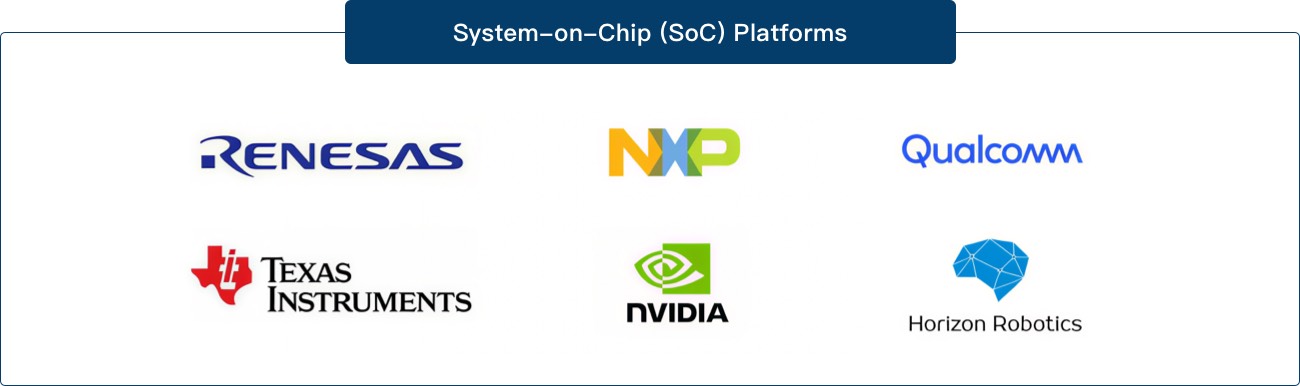
Compatible with a wide range of SoCs from leading semiconductor manufacturers and offers customized engineering services to meet diverse requirements.

Supports extensive and standard automotive hardware interfaces to connect various peripherals and communication networks, such as radar, cameras, displays, Ethernet, CAN/LIN, WiFi, Bluetooth, 4G/5G modules, etc.
Provides unified scheduling management, unified communication framework, standard data abstraction, automotive basic services, configuration management and other powerful infrastructure to create a safe, secure, reliable, and high-performance operating environment for application software.
