
Robotics

Delivers full-stack solutions that seamlessly integrate with mainstream SoCs and sensors, fully supporting the ROS ecosystem. The hardware includes core controllers, while the software features advanced brain and nervous systems, complemented by SaaS services to enhance robot intelligence.
Additionally, mature AMR/AGV/Embodied AI solutions facilitate rapid OEM product development and efficient mass production.
Embodied AI

Industry Challenges

Challenges in Data Collection and Model Generalization

  • Collecting real-world data is costly and time-consuming, and scenario coverage is limited.
  • Discrepancy between simulated environments and real-world conditions diminishes the reliability and generalization of models.
  • Traditional models are domain-specific and lack universal applicability.

Lack of Real-Time Performance

  • Conventional systems are non-real-time, causing unstable control and poor stability.
  • The real-time performance does not reach the microsecond level, hindering advanced control and complex interactive tasks.
  • Operating systems cannot provide hard real-time control (microsecond response) and resource-intensive tasks (large-scale decision-making).

Difficult Integration Caused by Fragmented Software Ecosystem

  • The communication protocols and data formats used by different vendors are often incompatible, necessitating tailored development efforts.
  • Lack of a unified development platform leads to redundant development.
  • Algorithm migration is costly, while development and integration processes require long cycles and incur high costs.

High operational costs

  • Operations and maintenance are handled reactively with fragmented processes and high costs.
  • There is a lack of efficient remote operations and maintenance tools.
  • Development and operational environments are decoupled, making problem reproduction difficult.

AutoCore Solution

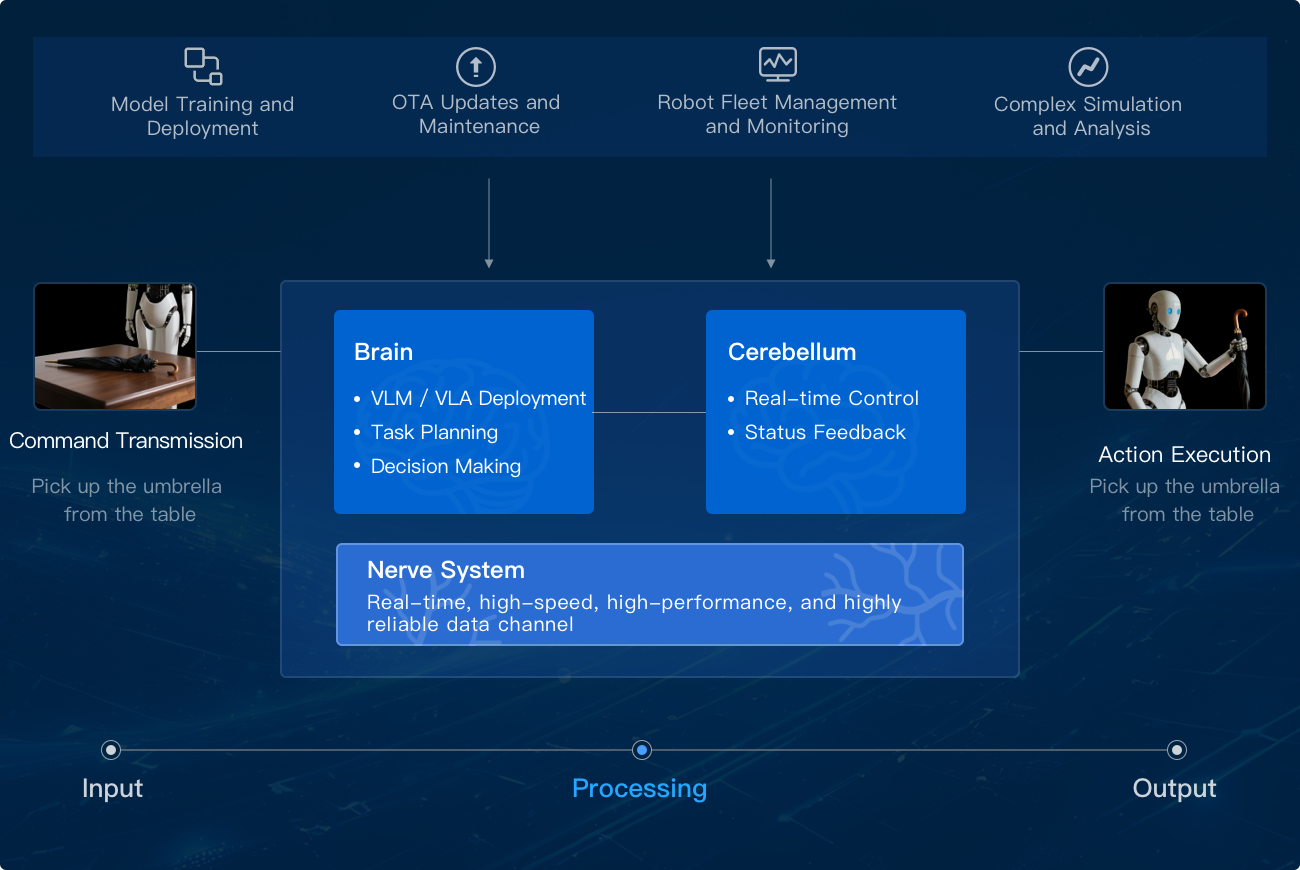
Based on AutoCore's integrated hardware-software robot core controllers and SaaS solutions, our innovative brain + cerebellum architecture combines deeply optimized large models and intelligent agent technologies to deliver a full-stack embodied AI solution.

Cloud

  • Model training and deployment
  • Robot fleet management and monitoring
  • Complex simulation and analysis
  • OTA updates and maintenance

Brain + Cerebellum

  • VLM / VLA inference
  • Task planning and decomposition
  • Human-machine interaction decision-making

Neural System

  • Real-time low-latency motion control
  • High-speed sensor data processing
  • Model acceleration engine

Solution Features

VLM / VLA Deployment

Builds an OS-level large model inference runtime environment with standardized interfaces and optimization libraries, enabling adaptation and deployment of pre-trained large models of different formats and structures to robot edge hardware.

End-to-End Simulation & Verification Platform

Provides a unified multi-framework, multi-model inference platform to support and verify the R&D, training, testing, and validation of embodied AI models.

Secure Boot and OTA

Provides secure boot and FOTA. Secure boot establishes a trust chain, while FOTA technology enables zero-downtime atomic upgrades.

High-Performance, High-Security Robot OS

Supports dual-kernel architecture Robot OS that balances hard real-time control (microsecond-level response) with resource-intensive tasks (large model decision-making).

Efficient Development Environment

  • Provides highly cohesive, loosely coupled modular software architecture, rich core middleware, and comprehensive development toolchain and SDK
  • Offers a unified communication framework (covering EtherCAT, CAN, DDS, and other heterogeneous protocols) to abstract differences and optimize transmission efficiency
  • Optimized mainstream robot software packages (such as ROS / ROS2 core packages) to support migration of existing ROS applications

Edge Large Model Acceleration Engine

Provides integrated large model inference runtime environment optimized specifically for robot edge heterogeneous computing platforms (CPU + GPU + NPU, etc.), empowering robots to efficiently run and schedule complex AI large models on resource-constrained edge devices, enabling advanced perception and understanding, complex autonomous decision-making, and smooth human-machine interaction at the edge.

Leading Metrics

End-to-end latency < 20 ms
Average latency from model prompt input to physical actuation: ≤ 5 ms
Deterministic scheduling jitter < 200 µs
Ethernet throughput in unified communication framework: ≥ 90% of UDP socket performance
System inference throughput > 500 tokens/sec
DDS communication performance exceeds native ROS 2 DDS: 5%
Multimodal VLM ≥ 10 FPS
Rejection rate for tampered secure-boot components: 100%
Motion control jitter < 10 µs (real-time kernel + EtherCAT)
Supports running critical-level tasks or applications concurrently: 3+

Usage Scenarios

Agriculture & Environmental Protection

  • Orchard harvesting robot (95% maturity detection accuracy)
  • Livestock monitoring drone (72 hr disease early-warning)
  • Solid-waste sorting robot (99% classification purity)

Industrial Robots

Dexterous arm (> 20 DOF) with vision-servo system for micron-level part handling (e.g., chip placement).

Companion Robots

Voice recognition, environment perception, continuous dialog, and simple body gestures.

Fueling Robots

Fuel cap identification and precise manipulator control for complete fueling operations.