
Provides safe, secure, and high-performance products and solutions. Core products include AutoCore.COMM and AutoCore.OS, along with integrated CCU/ZCU hardware and software, and SDV solutions. These enable the rapid and cost-effective development of next-generation in-vehicle computing platforms.
Built on an SOA framework to break down protocol, hardware, and system barriers, simplify the development chain, and meet future intelligent connectivity needs.
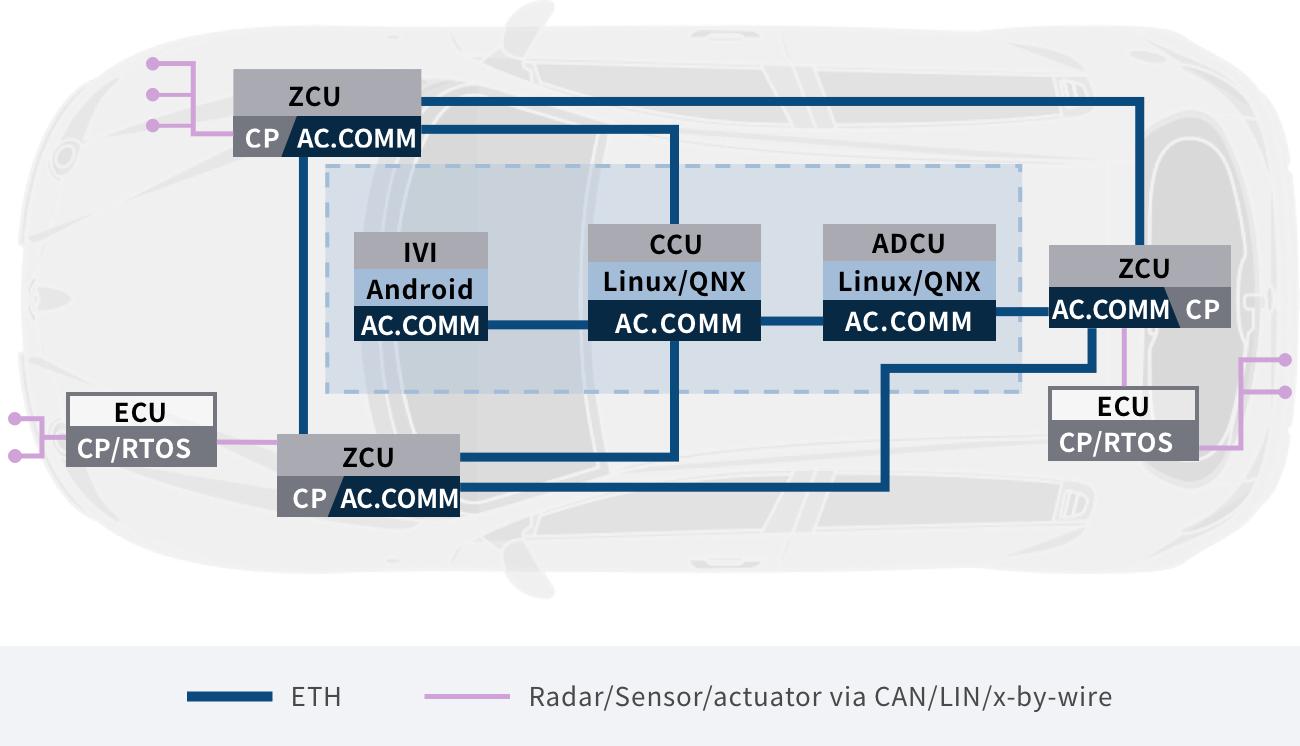

Empowering SDV: Compatible with domain/central computing architectures, supporting next-gen vehicle networks
Elastic Architecture: Abstracts low-level complexity, flexibly supports both distributed and centralized scenarios

ASIL-D Certification: Protocol stack / Time synchronization
Cybersecurity: Encryption and authentication / Access control
Code Compliance: MISRA-C / AutoSAR C standards

High Throughput: Shared memory > 20Gbps, Ethernet utilization > 95%
Low Latency: Local < 4 μs, Ethernet domain < 500 μs (32KB load)

Toolchain: Auto-generates code/configs, supports full design-to-debug process
Easy Deployment: Unified interfaces + standardized tools, supports customization and field integration

Provides a ready-to-use SOA framework that minimizes implementation workload by abstracting communication layers and offering comprehensive engineering support, including documentation, customization plans, and training.

Supports multiple OS (Linux/QNX/Android); is compatible with various communication media (UDP/SHM/DDS/IPC); and offers rich QoS strategies to meet diverse scenario needs.

Incorporates system-wide components that meet ISO 26262 ASIL-D functional safety standards and ISO 21434 cybersecurity standards.

Ultra-high throughput: Ethernet bandwidth utilization > 95%;
Microsecond-level latency: Local transmission via shared memory < 4 μs

Reduces development cycles by up to 50%, with prebuilt reference topology, deployment plans, and simulation tools to help customers quickly build network architectures, reducing trial-and-error and avoiding redundant work.

Provides standardized development interfaces, configuration toolchains, and reference frameworks to simplify processes and reduce costs; supports various hardware platforms and OSs to prevent vendor lock-in.

Supports full backbone network coverage, ensuring compatibility with future technology upgrades and extending product lifecycle.

Delivers real-time communication to meet intelligent driving and V2X needs, enhancing product performance differentiation.

Real-time data transmission between sensors (cameras, radar, LiDAR) and domain controllers:

Integrates multi-screen displays, multimodal interaction, and acoustics for immersive experience while ensuring responsiveness of critical driving features:

Large-scale data exchange between vehicle and cloud (e.g., HD map updates, AI model deployment), requiring both efficiency and security:

In zonal architectures, integrates various in-vehicle protocols (Ethernet/CAN/LIN) to enable cross-region service invocation and resource reuse:

Links intelligent driving, cockpit, and body domains (e.g., parking scenarios with cockpit prompts and door control), requiring SOA service integration:
