
(April 1, 2026, Nanjing) – AutoCore officially launches AutoMinds™, an industrial automation control software platform. The platform systematically provides a full-stack, self-controlled software foundation for next-generation intelligent industrial control scenarios, including PLCs, DCSs, and intelligent controllers.
AutoMinds™ has already established partnerships with multiple large domestic equipment manufacturers, with key performance indicators on domestic processor platforms comprehensively exceeding design requirements, validating the platform's technical maturity in industrial control scenarios.
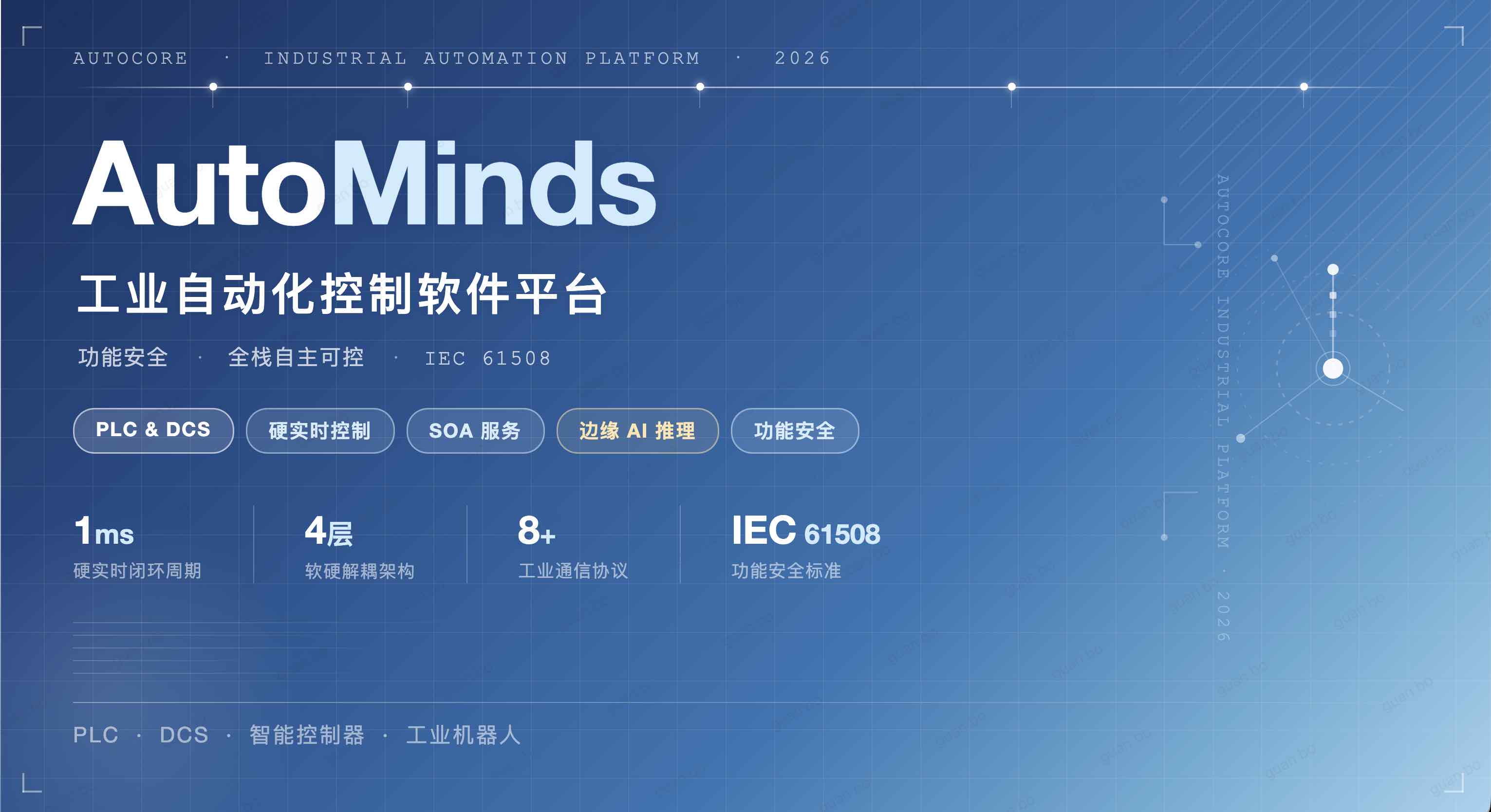
The industrial control sector currently faces four structural challenges:
AutoMinds™ is designed to address these challenges — not simply to replace a specific PLC programming environment, but to provide a full-stack industrial control software platform spanning from real-time kernels to communication, task scheduling, OT/IT convergence, functional safety, and application frameworks.
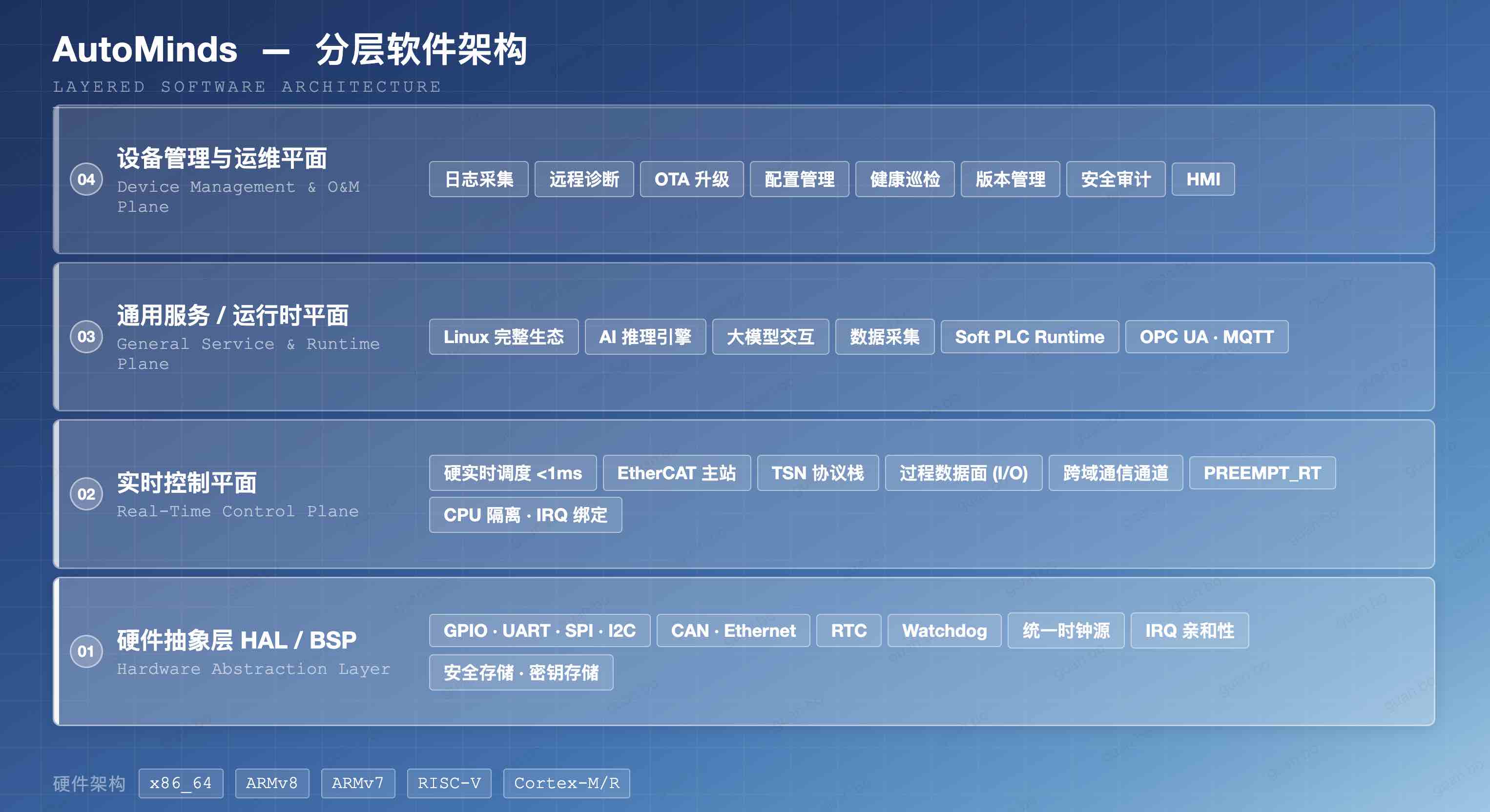
AutoMinds™ adopts a four-layer decoupled architecture that completely isolates underlying hardware differences from upper-layer control logic:
The platform supports three deployment modes: standalone, dual-redundancy, and simulation/virtualization. It is compatible with mainstream hardware architectures including x86_64, ARM, and RISC-V, as well as mainstream operating systems such as bare-metal, Linux, VxWorks, and QNX. When chips are replaced, upper-layer control logic and application software require no restructuring, enabling long-term software asset reuse.
In completed projects, this architecture has been validated on domestic ARM processors through multi-gradient extreme stress testing. Hard real-time task scheduling jitter and interrupt response latency significantly outperform general industry benchmarks, maintaining stable deterministic performance even under extreme scenarios with simultaneous CPU overload, memory pressure, and I/O stress.
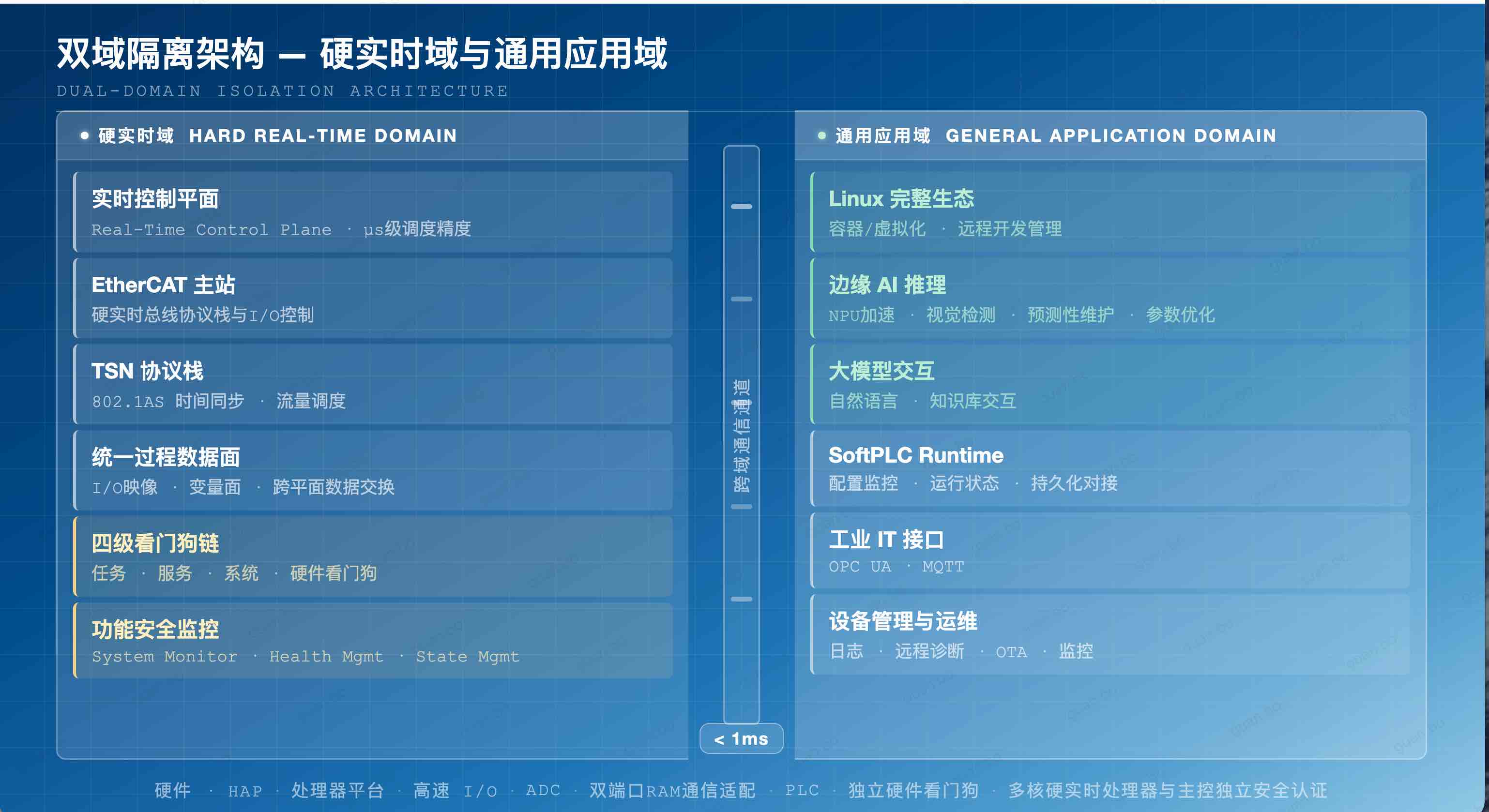
AutoMinds™ clearly defines real-time levels covering different industrial control real-time requirements:
The unified execution management service supports process/service start, stop, restart, dependency control, and ordered boot sequencing with a complete state machine. It also provides heartbeat, keep-alive, fault reporting, and automatic recovery strategies, implementing four-level fault recovery at the thread, process, service, and node levels.
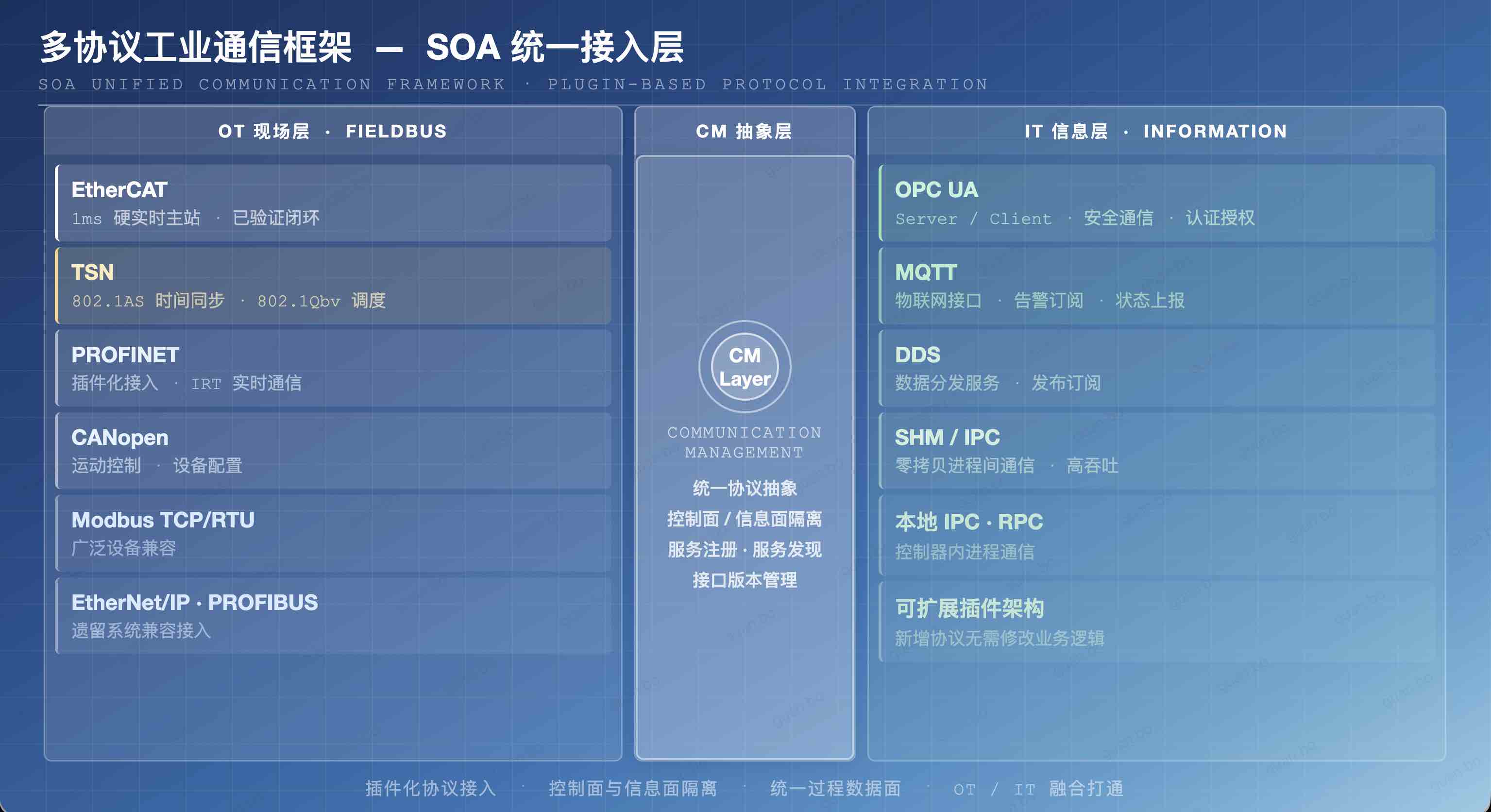
Unlike traditional PLCs that support only a single fieldbus protocol, AutoMinds™ inherits AutoCore.OS's mature SOA architecture. Through a unified Communication Management abstraction layer that shields underlying protocol differences, it supports plug-in integration of multiple mainstream industrial communication protocols:
The platform supports control plane and information plane isolation, enabling I/O image, variable plane, and cross-plane data exchange through a unified process data plane. Taking EtherCAT as an example, AutoMinds™ deeply integrates the EtherCAT master protocol stack with the Runtime hard real-time framework, achieving 1ms-cycle hard real-time closed-loop control, with communication stability and reliability validated through long-duration continuous operation scenarios.
AutoMinds™ is not just a PLC runtime, but an industrial communication platform capable of bridging OT (Operational Technology) and IT network boundaries. Validated results show that cross-domain communication latency between the hard real-time domain and the general application domain is far below millisecond-level requirements, fully meeting the real-time data interaction needs of monitoring, data acquisition, AI collaboration, and other scenarios.
To maximize compatibility with existing PLC ecosystems, AutoMinds™ provides deep integration capabilities with SoftPLC Runtime:
This capability enables customers to retain existing SoftPLC Runtime engineering assets while gaining comprehensive enhancements from AutoMinds™ in functional safety, cybersecurity, hard real-time control, and intelligence.
AutoMinds™'s dual-domain architecture provides a natural runtime environment for industrial intelligence. While the hard real-time domain ensures control determinism, the general application domain, based on the complete Linux ecosystem, natively supports the deployment and execution of AI inference and large model capabilities:
Persistence & Configuration Management: AutoMinds™ supports atomic commits, power-failure protection, versioning, checksums, and rollback, ensuring critical data is never left in a "half-written" state due to a single power loss. Boot parameters, device configurations, and application configurations are managed in layers, with audit logs and key configuration change tracking.
Reliability & High Availability: The platform provides a four-level watchdog chain — task watchdog, service watchdog, system watchdog, and hardware watchdog — supporting detection of abnormal exits, deadlocks, livelocks, resource leaks, and cycle timeouts. For high availability, it supports single-node self-recovery and dual-machine hot/warm/cold standby, providing fail-safe states and controlled degradation mechanisms, as well as crash snapshots, core dumps, and recent fault window data preservation, ensuring single-point software failures do not render the entire system unrecoverable.
Functional Safety: AutoMinds™ inherits AutoCore.OS's standards-compliant functional safety framework, providing a three-level hierarchical monitoring mechanism — System Monitor, Health Management, and State Management. The Health Management module monitors application runtime status in real time, supporting anomaly detection and automatic recovery to ensure continuous control system availability.
Cybersecurity: The platform features a built-in defense-in-depth architecture covering the complete security chain from OS kernel to middleware to application layer:
Internal Platform Interfaces: Provides unified service registration/discovery interfaces, unified message bus interfaces, shared memory process data interfaces, unified clock and timestamp interfaces, and unified health status, fault code, and recovery action interfaces, supporting service discovery, service registration, and interface version management.
Controller-to-Device Interfaces: Provides a unified device model that uniformly abstracts local I/O, remote I/O, and fieldbus devices, supporting plug-in integration of EtherCAT, CANopen, Modbus, EtherNet/IP, PROFINET, and PROFIBUS, as well as interface definitions for redundant links or redundant controllers.
Controller-to-Upper-Application Interfaces: Provides OPC UA Server/Client and MQTT interfaces, supporting log queries, status queries, and alarm subscriptions, with built-in authentication, authorization, and auditing capabilities.
Extensibility: The platform supports adding new bus drivers, new protocol stacks, and new runtime plugins; when adding new hardware board models, over 80% of middleware code can be reused; advanced features can be enabled via licenses or configuration.
Operations Interfaces: Provides export interfaces for logs, metrics, traces, core dumps, and packet captures; query interfaces for software inventories, version inventories, certificate inventories, and hardware capability inventories; upgrade, rollback, self-check, and health report interfaces supporting online log collection, offline diagnostic package export, and configuration snapshots.
AutoMinds™'s technical capabilities have been systematically validated at partner sites. A complete industrial controller system was built on a domestic ARM processor platform, including:
All functional and performance indicators met or exceeded design requirements, surpassing industry averages.
| Dimension | Traditional Solutions | AutoMinds™ |
|---|---|---|
| Software Independence | Dependent on overseas vendor runtime licenses | Full-stack self-developed |
| Safety Standards | Runtimes typically lack independent safety systems | Fully compliant with industry standard requirements |
| Real-time Architecture | Single real-time level | Soft/hard real-time levels with domain isolation |
| Communication | PLC runtime + standalone protocol stack | Integrated SOA communication framework |
| Intelligence Support | No native AI capabilities, OT/IT separated | Dual-domain architecture natively supports AI inference and large model deployment, OT/IT convergence |
| High Availability | Requires additional solutions | Built-in four-level watchdog, dual-machine hot/warm/cold standby, controlled degradation |
| Chip Adaptation | Typically bound to specific hardware platforms | Architecture-level hardware-software decoupling, supports x86/ARM/RISC-V, validated on domestic chips |
| Security System | Typically requires additional integration | Built-in sandbox, ACM, communication encryption, key management |
| Interface Openness | Closed ecosystem | OPC UA, MQTT, unified service bus, plug-in extensibility |
| Technical Validation Depth | — | Automotive mass production validated + industrial scenario PoC validated |
AutoCore is an intelligent mobile computing platform product and solution provider. With the AutoCore.OS software platform at its core, the company serves the intelligent automotive, industrial automation, and intelligent robotics sectors. Its core products fully comply with the highest-level functional safety and cybersecurity standard requirements. AutoCore has received investments from renowned institutions including Bosch Ventures, Foxconn, Hillhouse Capital, and IDG Capital, and has established deep strategic partnerships with STMicroelectronics (ST), Tenstorrent, Qualcomm/Advantech, and others.