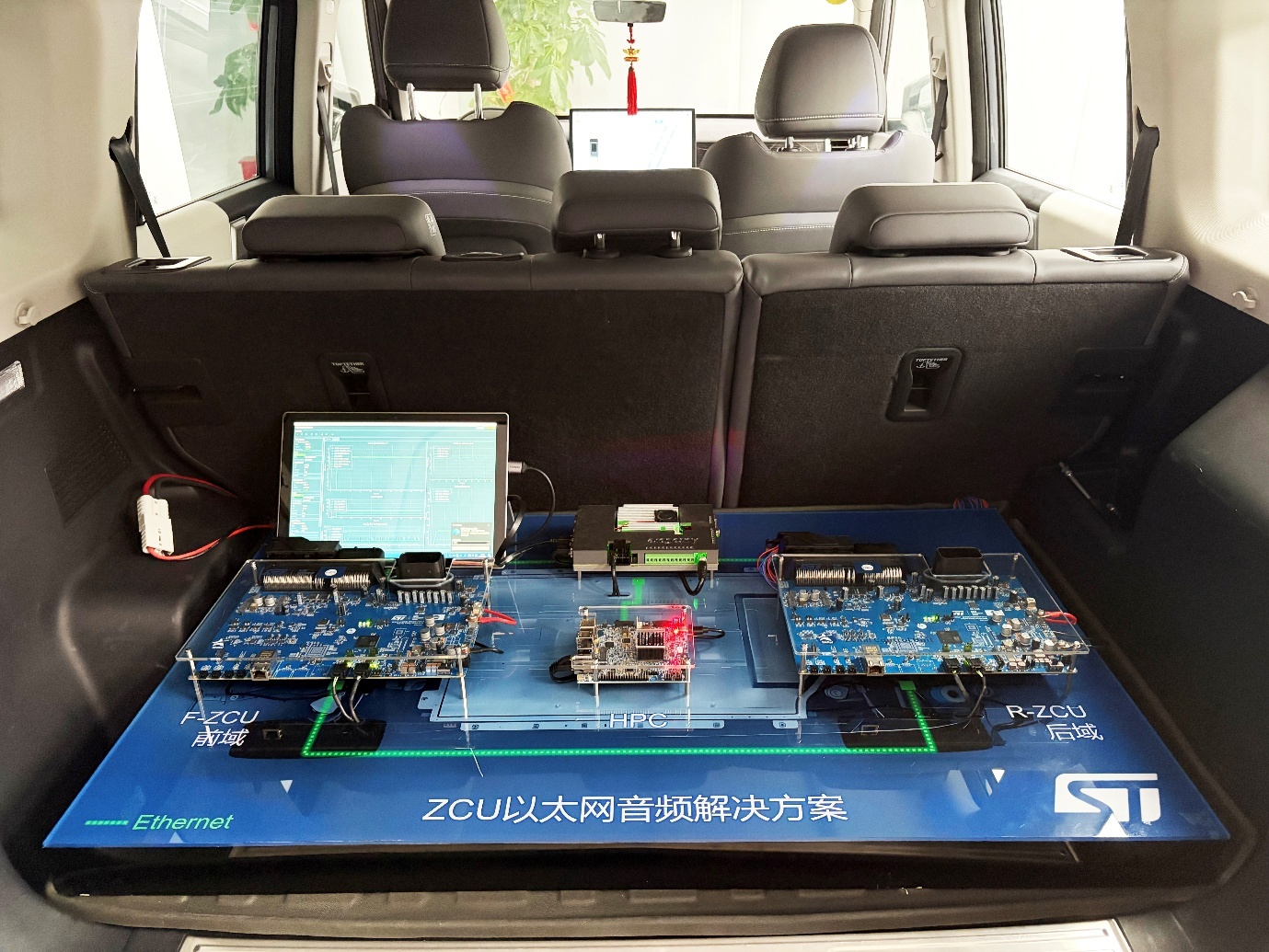
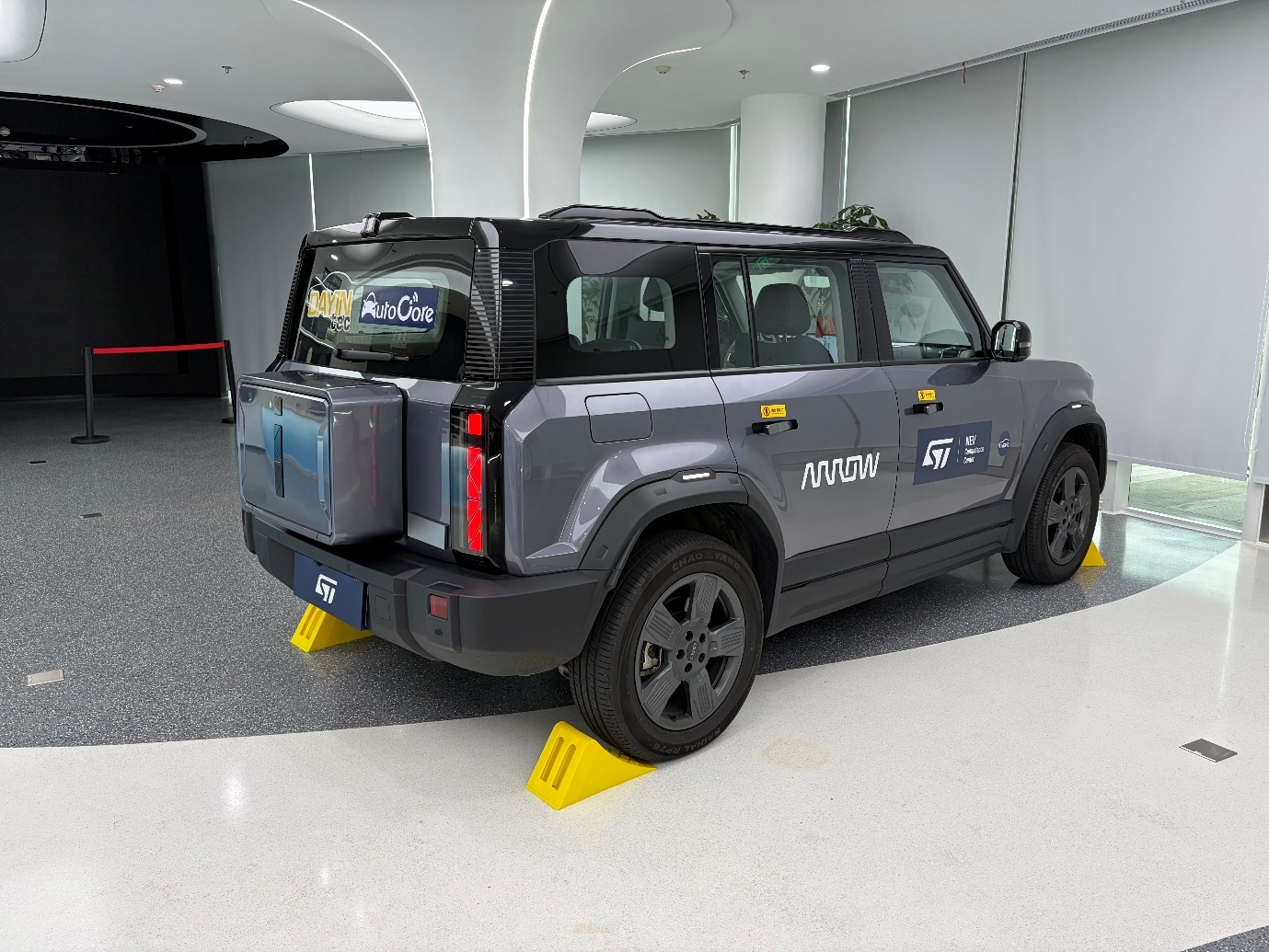
[Jul 3, 2026 | Nanjing / Stuttgart] — AutoCore, in collaboration with STMicroelectronics, showcased a joint pilot project at STARTUP AUTOBAHN Expo 2026 on July 2, 2026, in Stuttgart, Germany. Under the theme "Next-Gen Car Audio: Distributed Amps on Central Zonal & TSN," the project demonstrates a production-ready Distributed Amplifier over Automotive Ethernet solution built for the Software-Defined Vehicle (SDV) era.
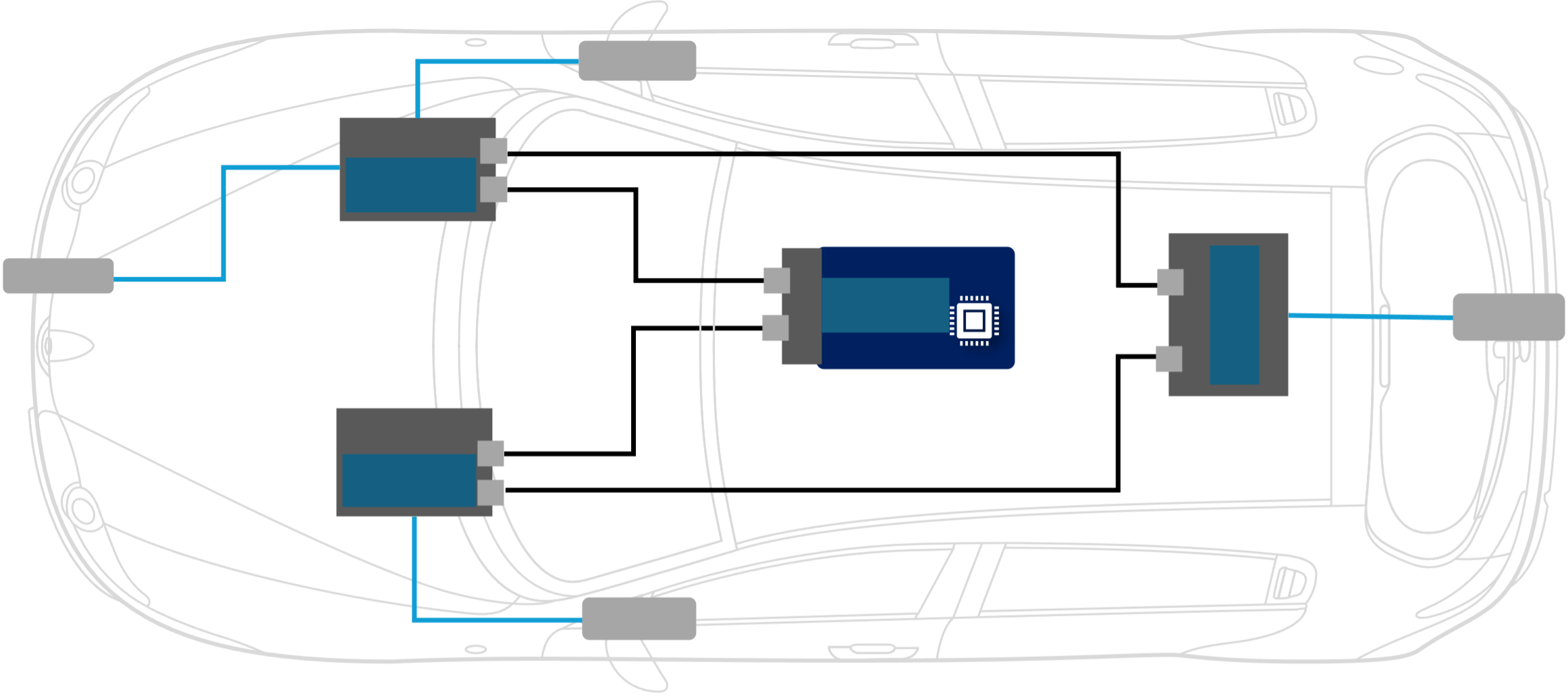
As central-zonal architecture evolves and the number of in-vehicle speakers grows, traditional A2B and centralized amplifier architectures face increasing constraints — lengthy wiring harnesses, heterogeneous audio sub-networks, and limited scalability. AutoCore and STMicroelectronics validated a reusable, scalable distributed amplifier system that leverages the existing in-vehicle Ethernet backbone, removes the need for a standalone audio network, and enables high-precision synchronized playback across multiple nodes.
The solution is built on AutoCore's full-stack SDV platform spanning the Central Computing Unit (CCU) and Zonal Control Unit (ZCU). AutoCore's CCU software architecture provides a layered foundation covering domain-specific applications, unified SOA services, AutoCore.OS platform middleware, hardware abstraction, multi-OS deployment, and heterogeneous computing hardware. This architecture supports independent application deployment and OTA updates, cross-domain service reuse, communication via SOME/IP, DDS, shared memory (SHM), TSN, and PCIe, as well as built-in diagnostics, OTA updates, and time synchronization.
Complementing the CCU, the AutoCore ZCU is designed around an automotive-grade Cortex-M multi-core MCU with asymmetric multi-processing (AMP). The service-core partition runs a lightweight automotive RTOS and supports SOA services, SOME/IP, DDS, TSN, service discovery, pub/sub, cross-ZCU routing, and lightweight OTA. The safety-core partition runs AUTOSAR Classic CP for real-time actuator control, power management, fault response, and ASIL B/D safety functions. The safety cores remain isolated from Ethernet, with data exchange handled through inter-core channels such as IPC, shared memory, inter-processor interrupts, and RPMsg Lite.
The joint pilot project uses distributed in-vehicle audio as a use case to prove the value of central computing plus zonal architecture. Instead of routing audio through a dedicated A2B sub-network and long analog harnesses, the system places amplifier functions closer to speakers and uses the vehicle Ethernet backbone for deterministic transmission.
STMicroelectronics and AutoCore contributed complementary capabilities to deliver the end-to-end system:
Key project challenges included achieving microsecond-level multi-protocol timing on real hardware and enabling coordinated operation across multiple protocols. Together, the teams built a full-stack pipeline from hardware drivers to the TSN/AVB protocol stack and audio applications, achieving deterministic Ethernet transmission and microsecond-level synchronized multi-node playback.
Benchmarked against a 32-speaker in-vehicle audio system, the pilot delivered measurable benefits:
The joint validation reinforces STMicroelectronics' ZCU audio/TSN platform capabilities and validates the maturity of AutoCore's TSN stack, giving OEMs a production-ready solution aligned with central computing and zonal E/E architecture trends.
Building on the validated distributed audio architecture, AutoCore and STMicroelectronics will continue to explore next-generation audio use cases, including full-scenario Active/Road Noise Cancellation (ANC/RNC) and immersive multi-zone personalized audio.
To learn more about STMicroelectronics' perspective on Audio over Ethernet and the Software-Defined Vehicle, visit ST's insights page: Audio over Ethernet & Software-Defined Vehicle — ST Essentials & Insights.
Dr. Yang Zhang, Founder and CEO of AutoCore, said: "We are redefining how next-generation intelligent mobility vehicles are built in the software-defined era — with performance, safety, and security at the core. The distributed amplifier system developed alongside STMicroelectronics is compelling evidence of what a full-stack CCU/ZCU platform can achieve: from zonal computing to TSN audio, we are turning the promise of the SDV into a validated, production-ready architecture."